Failure-to-Success Quotes: Turn Setbacks Into Momentum

From Flop to Fame: Quotes That Turn Setbacks Into Momentum
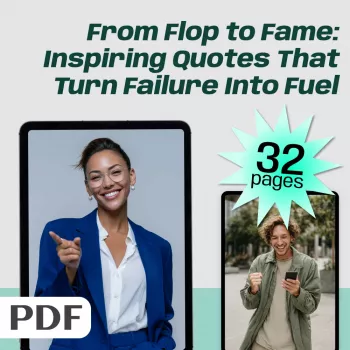
Failure can feel final in the moment, but it often becomes the raw material for growth, skill, and confidence. A well-timed quote can interrupt spirals of self-criticism, name what’s really happening, and point attention toward the next workable step. “From Flop to Fame” is a digital download eBook built for those moments—an easy-to-open guide of failure-to-success quotes designed to strengthen resilience, steady motivation, and help rebuild forward motion.
Why setbacks hit so hard—and why words help
Setbacks tend to trigger threat responses: narrowing attention, catastrophizing, and harsh self-talk that makes problem-solving harder. When the brain is in “danger mode,” long explanations don’t land well—but short, memorable lines can.
That’s where quotes shine. Think of them as mental “handles”: compact phrases that are easier to recall under stress than paragraphs of advice. The right quote doesn’t deny disappointment; it reframes it into something workable—information, training, or a signal to adjust strategy.
Resilience also grows through repetition. Returning to constructive meaning-making after a miss, a rejection, or a stall is a skill you can practice. Helpful context on resilience and coping can be found through the American Psychological Association’s resources on building resilience.
What “From Flop to Fame” is (and what it’s not)
This eBook is a curated failure-to-success quote collection meant to be used as a practical resilience guide, not just a read-once compilation. It’s designed for quick access during low-motivation days: skim a section, pick a line, and apply it to a real situation.
The focus is turning failure into fuel—persistence, learning loops, courage after embarrassment, and progress after setbacks. It fits well alongside growth mindset principles (see Stanford’s overview of Carol Dweck’s work) and actionable reflection practices discussed in leadership and performance contexts (explore Harvard Business Review’s writing on learning from failure).
What it’s not: a replacement for professional support when stress, anxiety, or depression feels overwhelming. It’s best used as a daily reinforcement tool—something small and steady you can return to when motivation wobbles.
Core themes that make failure feel usable again
- Growth over judgment: shifting from “What does this say about me?” to “What is this teaching me?”
- Process over outcome: focusing on actions that can be repeated and improved rather than one final score.
- Courage after embarrassment: rebuilding willingness to try again even when confidence dips.
- Persistence with flexibility: staying committed to the goal while being willing to change the method.
- Self-compassion with standards: being kind without lowering the bar—recovering faster and returning to effort sooner.
A simple way to turn a quote into an action plan
Quotes work best when they move from “inspiring” to “instructional.” Here’s a quick conversion method that keeps the next step small enough to do today.
- Name the flop in one sentence (facts only, no labels).
- Pick one quote that matches the moment (rejection, mistake, slow progress, fear of starting).
- Translate the quote into a micro-move: a 10–20 minute action that reduces overwhelm.
- Choose a repeatable cue (phone wallpaper, sticky note, calendar reminder) so the message shows up when needed.
- End with a quick debrief: one thing learned, one thing to adjust, one thing done well.
From setback to next step (quick conversion table)
| Setback moment | What the mind says | Quote focus to choose | Next 15-minute action |
|---|---|---|---|
| Rejection (job, pitch, application) | “I’m not good enough.” | Reframe rejection as data | List 3 improvements, send 1 follow-up, submit 1 new application |
| Public mistake or embarrassment | “Everyone saw me fail.” | Normalize learning in public | Write a 5-line lesson summary, practice the weak part once, try again |
| Slow progress on a goal | “This isn’t working.” | Commit to process over outcome | Track one metric, reduce scope, complete one small deliverable |
| Fear of starting | “What if I mess it up?” | Build courage through tiny reps | Open the doc, outline 5 bullets, do a rough first pass |
Use cases: where a failure-to-success quote guide fits best
- Students: exam setbacks, performance anxiety, and rebuilding study habits after a rough result.
- Creators and entrepreneurs: launches that underperform, criticism, inconsistent sales, and staying consistent through plateaus.
- Career transitions: layoffs, interviews that go nowhere, skill gaps, and maintaining confidence while retraining.
- Athletes and performers: missed goals, injuries, and returning to practice with a constructive mindset.
- Anyone rebuilding momentum: when motivation is low and the next step needs to feel small and doable.
Make it stick: habits that pair well with quote-based motivation
Digital download basics and how to get the most value
A 7-day reset challenge (small steps, real momentum)
Shop tools that support your reset
- From Flop to Fame: Inspiring Quotes That Turn Failure Into Fuel (digital download)
- Calvin Klein Men’s Leather Wallet
- Cordless Electric Nail Drill 30,000 RPM with Variable Speed for Manicure Pedicure
FAQ
What format is the eBook, and how is it delivered?
It’s delivered as a digital download after purchase. For the fastest access when you need it, save the file to your phone or tablet so it’s ready during low-momentum moments.
Can the quotes be printed for a journal, classroom, or office?
Printing selected pages can be a practical way to keep your favorite lines visible in a planner, journal, or workspace. For any broader use, follow the usage rights and terms listed on the product page.
How should it be used when motivation is at its lowest?
Use a simple 2-minute protocol: pick one quote, rewrite it in your own words, choose one 10–15 minute next action, and log one small win. The goal is to shrink the next step until it feels doable.















Leave a comment