Mental Toughness Workbook: 14-Day Plan for Resilience

Building Mental Toughness: A Practical Workbook-Style Guide for Stronger Mindset and Daily Resilience
Mental toughness is the trainable ability to stay steady under pressure, recover faster from setbacks, and follow through on priorities even when motivation dips. A workbook-style approach keeps it practical: small, repeatable practices that sharpen focus, calm stress responses, strengthen self-talk, and build consistency. The goal isn’t to “feel fearless.” It’s to make better next decisions—more often—especially on ordinary days when no one is watching.
What Mental Toughness Looks Like in Real Life
Mental toughness shows up in moments that rarely make a highlight reel. It looks like staying task-focused when discomfort arrives—boredom, doubt, frustration, or that urge to scroll instead of start. It’s the ability to respond instead of react: pausing before sending the text you’ll regret, quitting the workout, or abandoning the plan after a rough hour.
It also means recovering quickly after mistakes by shifting to problem-solving and concrete next actions. Another quiet marker is maintaining standards when no one is watching: consistency, honesty, and self-respect. Finally, real toughness includes flexibility—adjusting the plan without abandoning the goal. You can be committed and adaptable at the same time.
Common Myths That Make People Feel Stuck
A few misconceptions can make mental toughness feel unreachable. One is the idea that tough people never feel anxious or discouraged. In reality, toughness means acting effectively alongside those feelings. Another myth is that tough people push nonstop; in practice, recovery habits like sleep, boundaries, and pacing protect performance and prevent burnout.
It’s also easy to assume toughness is a personality trait you either have or don’t. Skills like attention control, emotion regulation, and disciplined routines can be trained. And while big breakthroughs are exciting, the most reliable confidence comes from small practices that compound over time—proof that you can keep promises to yourself.
The 4 Core Skills to Train (and How a Workbook Helps)
1) Focus control
2) Emotional regulation
Regulation isn’t suppression. It’s noticing what you feel, grounding the body, and choosing a response aligned with values. Short prompts and simple techniques (breathing, labeling emotions, body scans) make this trainable instead of theoretical. For additional research-based tools, the CDC’s coping with stress resources are a helpful reference.
3) Resilient thinking
Resilient thinking means moving from catastrophizing (“I always fail”) to accurate, useful thoughts (“I missed today; my next step is 10 minutes”). This isn’t forced positivity; it’s realism that leads to action. The American Psychological Association overview of resilience provides a solid framework for how resilience develops.
4) Follow-through systems
A Simple 14-Day Mental Toughness Practice Plan
| Day | Theme | Quick Prompt | Daily Action |
|---|---|---|---|
| 1 | Baseline | What situations challenge follow-through most? | Choose one goal for the next 14 days. |
| 2 | Values | Why does this goal matter in 3 sentences? | Write a 1-line reminder and place it somewhere visible. |
| 3 | Control | What is controllable today? | Do one controllable step in 10 minutes or less. |
| 4 | Self-talk | What’s the unhelpful script that shows up? | Rewrite it into a calm, accurate statement. |
| 5 | Stress reset | How does stress show up in the body? | Practice 3 minutes of slow breathing or grounding. |
| 6 | Friction audit | What makes starting hard? | Remove one barrier (prep, environment, timing). |
| 7 | Consistency | What does “minimum viable effort” look like? | Do the minimum version—no negotiation. |
| 8 | Discomfort | What feeling usually makes quitting tempting? | Stay with mild discomfort for 2 minutes longer than usual. |
| 9 | Setbacks | What’s a recent mistake to learn from? | Write the lesson + the next step only. |
| 10 | Boundaries | Where does time/energy leak? | Say no to one low-value request or distraction. |
| 11 | Confidence | What evidence shows progress already? | Record 3 small wins from the last 10 days. |
| 12 | Focus | What is today’s single most important task? | Do a 25-minute focused sprint. |
| 13 | Identity | Who is the person that keeps going? | Write a 2-sentence identity statement and act once like that person. |
| 14 | Plan ahead | What will derail this next week? | Create a simple if-then plan for the top 2 obstacles. |
Using a Digital Workbook Effectively (Without Overthinking It)
Once per week, schedule a 10-minute recap to notice patterns: what triggers avoidance, what restores focus, and what reliably works. The NIH Emotional Wellness Toolkit can complement this with additional grounding and coping ideas.
Who This Approach Fits Best (and When to Add Extra Support)
How to Track Progress Without Turning It Into Pressure
Workbook Option for Guided Practice
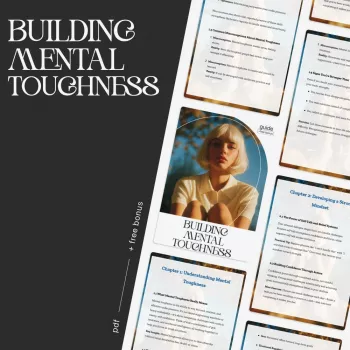
- Building Mental Toughness Guide | Digital Download for Personal Growth | Mindset Strength Workbook | Self-Improvement eBook | How to Build Mental Toughness
- Calvin Klein Men’s Leather Wallet (use it to carry a one-line values reminder or a tiny “if-then” plan card)
- 2pcs Set Reusable Baby Blanket Storage Bag (a simple way to keep printed pages, a notebook, and pens together so starting takes less effort)
FAQ
How long does it take to build mental toughness?
Most people notice meaningful improvement within 2–4 weeks of consistent practice, especially in follow-through and recovery after setbacks. Deeper change comes from repeating the same skills across different situations for several months.
What’s the difference between mental toughness and being emotionally numb?
Mental toughness includes awareness and regulation of emotions, not shutting them off. It’s the ability to feel normal anxiety, frustration, or doubt—and still choose effective actions aligned with your values.
What if motivation is low and discipline keeps failing?
Use minimum-viable habits, reduce friction (prep your environment), and create simple if-then plans for predictable obstacles. Track inputs and reset quickly after missed days so one slip doesn’t turn into a week.















Leave a comment